Thursday, October 28, 2010

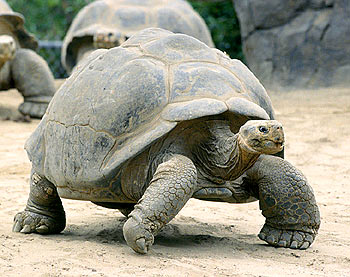
The Galápagos Islands Tortoise


The Galápagos Islands Tortoise is the largest tortoise in the world, reaching over 800 pounds and lengths of over six feet. They usually live to be around 150 years old. The oldest giant turtle, named Jonathan, lived to be 175 years old. These extraordinary animals can go a year without food or water and still maintain a weight of 550 pounds. The Galápagos Islands Tortoise can accomplish this by sleeping for around 16 hours a day. The ancestor of these animals was most likely a regular sized tortoise.
They could have become larger after their arrival due to the fact that there was no longer a need to hide from predators and that
there was no competition for food. As the tortoises spread to different islands, they turned into the different races that we have
today. Of all the amazing animals on The Galápagos Islands, The Galápagos Islands Tortoise is definitely one of them.

Wednesday, October 6, 2010

Biodiversity

Q: What are ways in which preserving biodiversity locally might have a global effect?
A: The rainforest and the animals that live in it have been described as the lungs of the Earth. The rainforest is responsible for turning 20% of the Earth's carbon dioxide into oxygen. With the deforestation of the rainforest comes more carbon dioxide in the atmosphere. This could result in a much warmer climate because of the greenhouse effect.

Source: http://www.rain-tree.com/facts.htm

Q: How do habitat destruction and loss of species affect more than just one area?
A: The Global Biodiversity Outlook and the world bank have done research and found that if 20% of the Amazon rainforest is deforested, it would cause a significant dieback of other forests around the world.

Q: How does preserving biodiversity enhance the life of people?
A: Having biologically diverse ecosystems enhance the lives of people because ecosystems with more diversity are healthier and healthier environments mean better resources.

Tuesday, September 21, 2010

Gasses and Climate Change

1. Combustion Demo
Hypothesis: If the rubbing alcohol is ignited, then it will create a noise and black soot.
Observation: My hypothesis was correct. The rubbing alcohol ignited and created a large blue flame, along with a "wooshing" noise and shot the bottle 8 feet. After the bottle was looked at more closely there was condensation and black soot.

Today I learned that combustion can cause a warming affect on the Earth. This change in the Earth's climate can destroy natural habitats that once flourished.

2. CO2 Gas Demo
Hypothesis: If the gas is put near a flame, then it will ignite.
Observation: My hypothesis was incorrect. Gas put out out the flame because there was not enough oxygen for the flame to continue to burn.

3. Hydrogen Gas Demo
Hypothesis: If the liquid is combined with the metal, then it will turn into a gas.
Observation: My hypothesis was partly correct. There was a gas produced after the experiment that was flammable. When it was ignited it made a popcorn like noise. The metal was also dissolved.

4. Air Pressure Demo
Try #1
Hypothesis: If the can with steam in it is placed in the ice water, then the steam will turn back into water because of condensation.
Observation: My hypothesis was incorrect. Nothing happened.
Try #2
Hypothesis: If the can is paced in the ice water upside down, then bubbles will come out of the water.
Observation: My hypothesis was incorrect. The can crushed as soon as it touched the water.

Research: For the first time ever, scientists have noticed a change in air pressure caused by humans. The air is moving in different patterns which is causing less rain in certain areas an more in others. The circulation of different temperature is gradually warming the Earth, contributing to the global climate change.


Tuesday, August 31, 2010

Ten Years of the Chornobyl Era Questions

1) What is radiation and how can it affect the human body?

2) How was the Chornobyl disaster caused?

3) How many times more radiation was let out during the disaster than in the Hiroshima bombing? How much radiation was let out?

4) How many square kilometers where contaminated? What countries where affected?

5) What is being done to stop the radiation from spreading?

Monday, August 30, 2010

5 Pannel Questions

1) How many of you think that the canal is safe?

2) What have agencies done to clean up the mess?

3) Is there any proof that there is still enough chemicals to cause birth defects or kill someone.

4) How many chemicals are left and how much of it.

5) Would you live there today?

Catalyst 8-30-10 Answers


1.)What caused the toxic waste to begin being pushed to the surface?
Answer: The blizzard and heavy rain of 1977 filled the "bathtub" where the chemicals where. When the "bathtub" filled, a water chemical sludge oozed out and contaminated storm drains, wells, and even streams around the love canal area.

2.) What are some of the health hazards associated with the chemicals dumped there?
Answer: The problem with the Love Canal disaster is that nobody really knew what was dumped into the canal. Also, because the EPA had just started, there was very little knowledge on what these chemicals could do. All they really knew was that there was dioxin in the canal which could cause birth defects.

3.) Besides humans how are other parts of the ecosystem affected by this?
Answer: The parts of the ecosystem that where affected by this where, the underground animals like ground hogs or even the worms; the fish that swam in the contaminated streams; any animal that drank the contaminated water; and lastly, any animals that ate the smaller animals, like bears.

Friday, August 20, 2010

Hazards of Oil Dispersants


1. While researching the effects of chemical dispersants I found some pretty startling things. I found that British Petroleum is using a chemical called Corexit which alone is extremely toxic, but when combined with oil is even more toxic. When oil is left alone it does not sink as fast so it is much less harmful. If oil does not sink it cannot harm the coral, grasses, or smaller animals; but with dispersant it harms anything below the oil, above the oil, or around the oil. If smaller animals ingest the polluted grass they will become contaminated, which will contaminate everything above the small fish in the food chain.

2. Wether or not fixing one problem creates another depends on what you are dealing with. For example, if you spill some water and you wipe it up, you aren't creating a new issue. But, in British Petroleum's case yes. The oil spill by itself was extremely devastating but by adding the toxic dispersant, they are creating a combination that is even more lethal than the oil itself. When the oil is left alone, it can bio degrade very easily, but with the dispersant it remains in the water for may more years. In conclusion, when British Petroleum added the dispersant, they created a worse problem than they had before.

3. In my opinion, the chemical dispersant is way more toxic than the oil. The dispersant also allows the oil/chemical mixture to go places that would have never been harmed by the spill without the introduction of the chemical dispersant. The chemical dispersant also allows the oil to get into fishes gills and other parts of their bodies which could contaminate millions of fish that would have been unaffected by the spill. In other words, the introduction of the chemical dispersant has caused much greater disaster than if the oil was just left alone.